There’s a moment — usually somewhere around sunset, when the light turns the sand into something molten and almost unreal — when you fully understand why people travel so far just to stand in a desert. The Erg Chebbi dunes in southeastern Morocco are one of those rare places that genuinely live up to the anticipation. Maybe even exceed it, which is saying something.
This guide covers everything you’d want to know before visiting. How to get there, when to go, what to actually do, where to sleep, and a few things that trip people up. I’ve tried to keep it honest and practical — because the last thing you need when you’re planning a Morocco desert trip is vague advice dressed up as poetry.
What Are the Erg Chebbi Dunes?
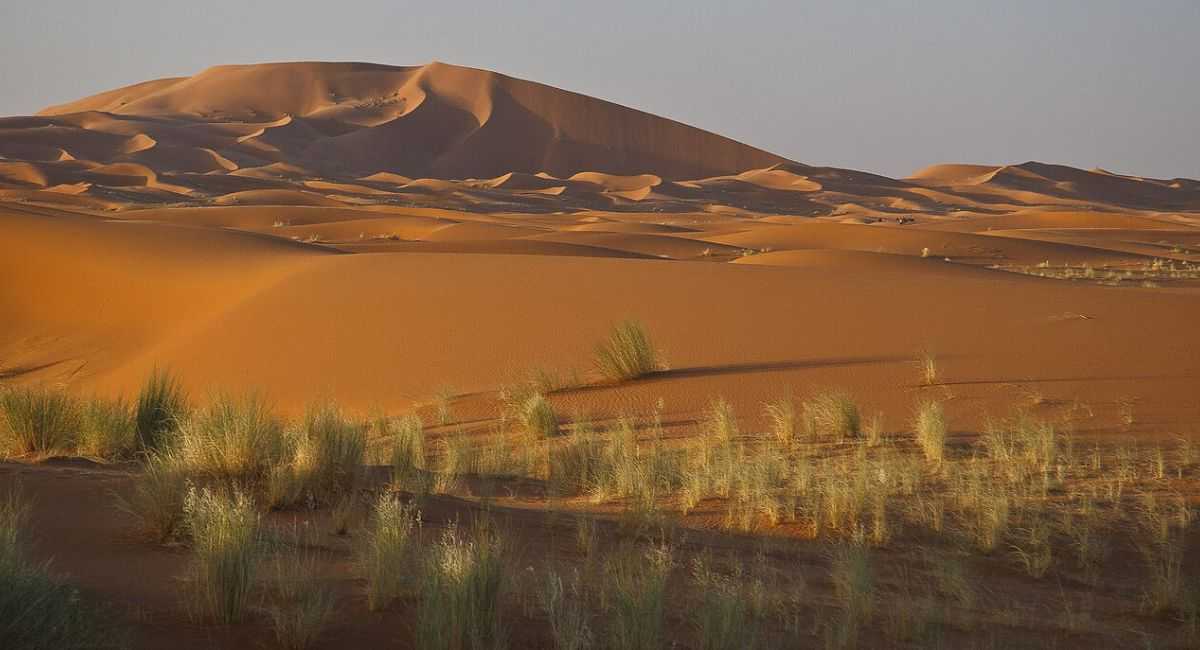
An erg is a vast expanse of sand shaped by wind over thousands of years. The Erg Chebbi dunes are a roughly 22-kilometre-long, 5-kilometre-wide sea of orange and golden sand sitting near the village of Merzouga in Morocco’s Drâa-Tafilalet region — right on the edge of the Sahara, close to the Algerian border.
What makes them special? A few things. The dunes here reach up to 150 metres in height, which is genuinely impressive when you’re standing at the base of one and looking up. The colour shifts dramatically throughout the day — pale gold in the morning, deep amber at noon, nearly rust-red as the sun drops. And because the area sees relatively fewer visitors compared to parts of the Sahara further east, it still feels — most of the time, at least — like actual wilderness.
| “The Erg Chebbi dunes are among the most accessible stretches of true Saharan sand in the world — and in my opinion, among the most beautiful.” |
It’s worth noting that Morocco has two major ergs. The other is Erg Chigaga, further southwest near M’hamid. Both are beautiful in their own way. Erg Chebbi tends to be more visited — partly because it’s easier to reach, partly because the infrastructure around Merzouga is genuinely well developed. If you want something more remote, Erg Chigaga is worth investigating. But for most travellers making a first desert visit, Erg Chebbi is the one.
Getting There
Merzouga — the village closest to the Erg Chebbi dunes — is around 550 km southeast of Marrakech. That sounds far, and honestly it is. Plan accordingly.
By Car or Private Driver
The most flexible option. The drive from Marrakech via the Tizi n’Tichka mountain pass and Ouarzazate takes roughly 8–10 hours, depending on stops. The scenery along the way — kasbahs like Ait Ben Haddou, gorges, lush river valleys — is genuinely worth seeing. Many people treat the drive itself as part of the experience. Shared taxis from Ouarzazate to Merzouga are cheaper but involve multiple changes and long waits.
By Bus
CTM and Supratours run overnight buses from Marrakech to Merzouga. Budget-friendly but not exactly comfortable — you’ll arrive early morning with no sleep and sandy eyes. A neck pillow and managed expectations help considerably.
By Organised Tour
Many visitors combine the Erg Chebbi dunes with a broader Morocco desert tour of southern Morocco, usually starting or ending in Marrakech or Fes. At MT Toubkal Trek, we run Sahara tours from Marrakech that incorporate Merzouga as part of a wider southern Morocco loop — worth considering if you’d rather not worry about logistics yourself.
| 💡 Tip: The road from Rissani to Merzouga is fully paved and straightforward. A standard car handles the main route without issue. Only venture off the main track if you’re with a guide or know exactly what you’re doing. |
Best Time to Visit the Erg Chebbi Dunes
The Erg Chebbi dunes can technically be visited year-round, but there are real and significant differences between seasons. For a broader look at timing your Morocco trip, our guide on the best time to travel in Morocco covers the full picture.
| Spring — Mar to May
Warm and pleasant. Wildflowers occasionally appear after winter rains. Gets busier as Easter approaches — expect more visitors from April onwards. |
Summer — Jun to Aug
Brutal. Temperatures of 45°C are not unusual. Activities shift to very early morning or after dark. Not recommended for first-time visitors. |
| Autumn — Sep to Nov
Temperatures drop from October. Excellent light for photography, manageable crowds. One of the better overall windows for a visit. |
Winter — Dec to Feb
Peak season. Days mild and clear, nights near freezing. Stargazing is exceptional. Book camps well in advance — they fill fast. |
If I had to pick one window, I’d say October to early December. The worst of the heat is gone, the dunes aren’t overrun with tourists, and the sunsets have a quality of light that’s genuinely difficult to describe. January and February are lovely too — our Morocco weather in February guide has more detail — just pack for cold nights, because the desert chill catches a lot of people off guard.
Worth noting: the Merzouga International Music Festival typically takes place in May, drawing performers from across the Sahara region. If you happen to be planning around that time, it’s worth a look.
What to Do at Erg Chebbi
Camel Trekking
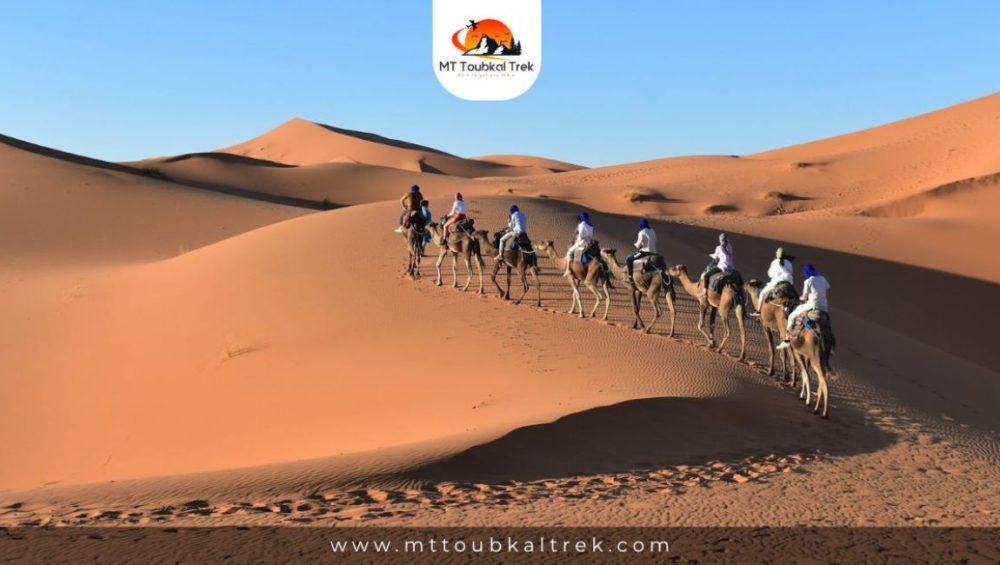
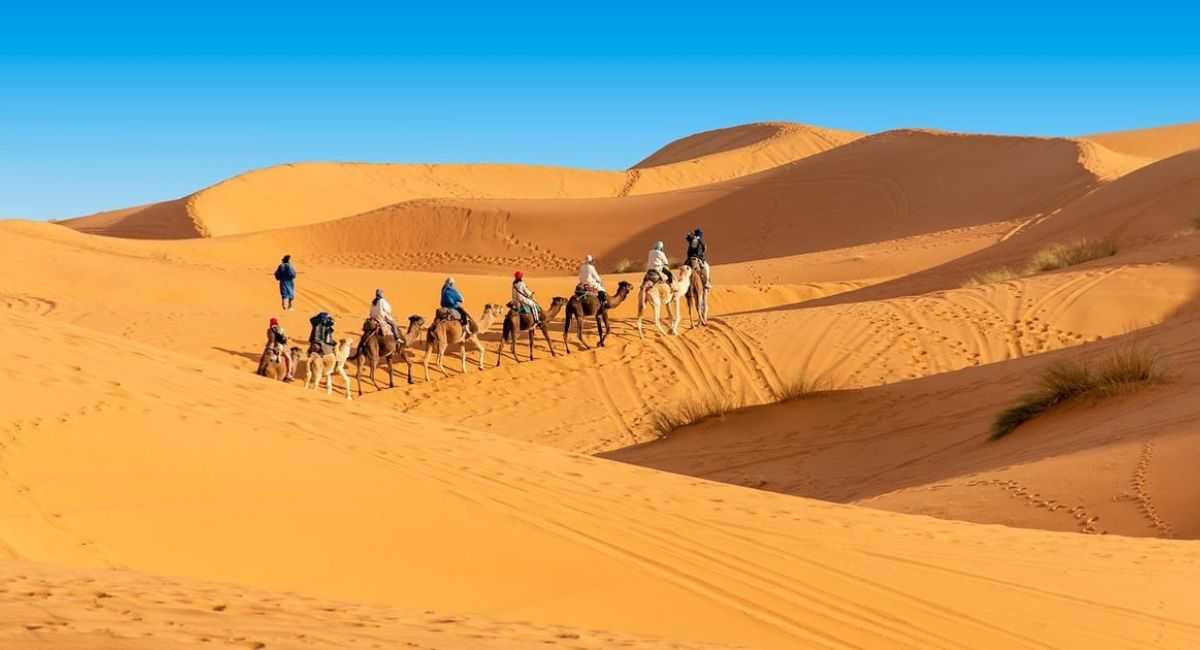
This is, honestly, what most people come for. A camel trek — typically a one-to-two-hour ride into the dunes at sunset, timed so you arrive at a desert camp just as the light disappears — is the defining Erg Chebbi experience. It’s a little slow, slightly uncomfortable if you’re not used to it, and completely worth it.
Longer multi-day camel routes in Morocco are also possible for those with more time, covering larger stretches of the Erg Chebbi dunes and reaching more isolated camps that day-trippers never see. These are arranged through local guides in Merzouga.
Climbing the Dunes on Foot
Climbing the dunes — particularly the highest ridge near Hassi Labied — rewards the effort with sweeping views across the entire erg. Go at sunrise. The light is extraordinary, the temperature is manageable, and you’ll probably have the summit to yourself before the tour groups arrive. Wear shoes with some grip. Climbing loose sand barefoot sounds appealing until you try it.
Sandboarding
A growing activity around the Erg Chebbi dunes. Boards can be rented from operators in Merzouga. It’s genuinely fun — particularly for younger travellers or anyone with a snowboarding background. The dunes closest to town tend to have the best slopes.
4×4 Desert Excursions
If you’d rather cover more ground, 4×4 excursions go deeper into the erg and sometimes out to the nearby fossil-rich plateaux or ksar ruins at the desert’s edge. Our full Merzouga desert guide covers all the excursion options in detail.
Stargazing
I think this deserves its own mention, even if it’s technically just ‘being outside at night.’ Well away from any meaningful light pollution, the Milky Way is visible to the naked eye on clear nights. If you’ve spent most of your life under city skies, the Erg Chebbi sky will likely be one of the most memorable parts of the trip.
Staying Overnight in the Desert
Sleeping in the Erg Chebbi dunes — actually in the dunes, not just nearby — is probably the most transformative part of the experience. There are two broad options: luxury glamping camps and more traditional Berber-style camps.
Luxury Desert Camps
These have grown considerably in recent years. Expect private tents with real beds, en-suite bathrooms, and sometimes heating or air conditioning depending on the season. Dinner tends to be a generous Moroccan spread, followed by live music around the fire. They’re not cheap — typically €100–€250 per person per night — but for a one-off experience, a lot of people feel it’s worth every dirham.
Traditional Berber Camps
More basic. Shared facilities, simpler food, sleeping mats rather than beds. Much cheaper. And for many travellers, actually more atmospheric — you’re just lying there under the stars, listening to the wind moving across the sand. These usually run €30–€70 per person, including dinner and breakfast. If you’re drawn to authentic Berber culture in Morocco, this style of camp is the more immersive choice.
| ⚠️ Important: Book ahead, especially between October and March. The better camps — luxury and traditional alike — fill up weeks in advance during peak season. Don’t assume you can sort it on arrival, because you almost certainly can’t. |
Most camps include the camel ride in and out as part of the package. Some also offer 4×4 transfers for those who prefer it — worth asking about if you have mobility concerns or are travelling with young children.
Practical Tips for Visiting Erg Chebbi
A few things that might save you some frustration along the way. If you’re starting your trip in Marrakech before heading south, our Marrakech travel guide and day trips from Marrakech page are useful prep reading.
Clothing: Loose, lightweight layers work best. The sun reflects intensely off sand. A scarf or keffiyeh is genuinely useful — both for sun protection and to keep sand out of your face. Evenings and nights can get genuinely cold from October to March, so pack accordingly.
Footwear: Sandals are fine around camp. For dune climbing, closed shoes with grip are significantly better. Flip-flops on steep loose sand lead to a slow, undignified slide back down.
Cash: Merzouga runs largely on cash. The nearest ATM is in Rissani, roughly 20 km away. Sort this out before you arrive rather than hoping something will materialise at the last minute.
Connectivity: Mobile signal exists in Merzouga town and at most riads and camps. It fades as you move deeper into the dunes. Consider that a feature rather than a drawback.
Bargaining: Expected and entirely normal. Stay polite — a few extra dirhams matters considerably more to the local seller than it does to you.
Sand in everything: It gets into your camera, your bag, your ears, your water bottle. Bring a sealed bag for electronics and accept the rest with good humour. It’s part of the deal.
Combining Erg Chebbi with Other Morocco Destinations
The Erg Chebbi dunes are rarely a standalone trip. Most people fold them into a wider southern Morocco itinerary. Here are the natural pairings worth considering — and if you want a broader overview, our guide to the best places to visit in Morocco is a good starting point.
The Draa Valley: A long, palm-lined river valley dotted with ksour (fortified Berber villages) stretching from Ouarzazate toward M’hamid. Driving through it en route to Merzouga is genuinely one of the most scenic stretches of road in the country. It also features prominently in our guide to Morocco’s best destinations.
Todra and Dadès Gorges: Both are within a comfortable day’s drive of Merzouga. Todra Gorge — sheer walls of 300-metre rock pressing in on both sides — is particularly dramatic. Both gorges also make excellent bases for hiking in the Atlas Mountains if you want to extend your time in the region.
Fes or Marrakech: Most desert circuits begin or end in one of Morocco’s Imperial Cities. A popular option is our 3-day tour from Marrakech to Merzouga, which covers an enormous amount of Moroccan geography efficiently.
At MT Toubkal Trek, we offer multi-day tours that weave the Erg Chebbi dunes together with the Atlas Mountains, the Imperial Cities, and beyond. If you’d like a route built around your interests, get in touch with us — we’re happy to put something together that actually works for you.
KEY TAKEAWAYS
| 1 | The Erg Chebbi dunes near Merzouga are among the most spectacular stretches of true Saharan sand in the world, reaching up to 150 metres high. |
| 2 | The best time to visit is October through April. October to early December is a particular sweet spot — comfortable temperatures, excellent light, manageable crowds. |
| 3 | A sunset camel ride followed by an overnight desert camp is the classic experience. Book well in advance — camps fill up fast during peak season. |
| 4 | Beyond camel trekking, the area offers sandboarding, 4×4 excursions, sunrise dune hikes, and some of the best stargazing you’ll find anywhere. |
| 5 | Merzouga is roughly 550 km from Marrakech — plan a full travel day each way, or join an organised desert tour from Marrakech |
| 6 | Erg Chebbi pairs naturally with the Todra and Dadès Gorges, the Draa Valley, and Morocco’s Imperial Cities |
| 7 | Bring Moroccan Dirhams (ATM is 20 km away), pack warm layers for cold nights, protect electronics from sand, and wear proper shoes for dune climbing. |
Frequently Asked Questions
How long should I spend at the Erg Chebbi dunes?
At minimum, one night in the dunes. That gets you a sunset camel ride and a sunrise — the two peak moments. Two nights is ideal if you want more breathing room to explore on foot or by 4×4. Most travellers feel ready to move on after three nights — at which point Marrakech or Fes makes a natural next stop.
Is it safe to visit?
Yes, generally. The Merzouga area is safe and well-touristed. Standard travel common sense applies — don’t wander deep into the dunes alone without letting someone know where you’re going, particularly in summer. Dehydration is a real risk; the heat is more intense than it looks in photos.
Can I visit the Erg Chebbi dunes independently?
Absolutely. No guide is required. That said, having a local guide — whether for a camel trek, a 4×4 excursion, or simply navigating Merzouga’s options — almost always improves the experience. Local knowledge matters in a desert environment more than people tend to expect before they arrive.
What currency is used near Erg Chebbi?
Moroccan Dirham (MAD). Euros and US dollars are occasionally accepted at tourist-facing businesses, but at poor exchange rates. Use dirhams wherever possible. Sort out cash in Rissani (about 20 km away) or before you leave the city — don’t rely on finding an ATM in Merzouga itself.
Are the Erg Chebbi dunes worth the long drive from Marrakech?
In our experience, almost everyone who makes the effort says yes — and says it emphatically. The Erg Chebbi dunes are one of those places that stays with you in the specific way that genuinely remarkable places do. If you want expert help planning the journey, our Morocco travel agency team is always available to help.
Conclusion
The Erg Chebbi dunes are, without question, one of the most remarkable natural experiences Morocco has to offer. And Morocco, to be fair, has quite a lot to offer. But there’s something about this particular stretch of Saharan sand — the scale of it, the colour, the silence once the wind drops — that tends to stay with people long after they’ve left.
Getting there takes effort. It’s a long drive, the logistics require some planning, and the desert heat in summer is no joke. But the window between October and April is genuinely perfect for a visit — comfortable temperatures, extraordinary light, and nights so clear that the stars feel closer than they have any right to be.
Whether you come for the camel trek at sunset, the sunrise climb to the top of the highest dune, a night around the fire at a Berber camp, or simply the rare experience of standing somewhere that feels genuinely remote — the Erg Chebbi dunes will not disappoint. Most people who make the journey say it was the highlight of their entire Morocco trip. I think that’s probably right.
If you’re ready to start planning, MT Toubkal Trek is here to help. We offer everything from 3-day desert tours from Marrakech to fully custom southern Morocco circuits combining the dunes with the Atlas Mountains, gorges, and Imperial Cities. Whatever your timeline and budget, we’ll build something that actually suits you — not just another generic package.
The desert is waiting. The only thing left is to go.