The solo travel Atlas Mountains experience is one of Morocco’s most rewarding trips for independent travellers — and one that people who’ve done it consistently say exceeded their expectations. The region around Imlil village is genuinely well-set up for solo visitors: guesthouses are used to independent travellers, local guides are available without advance booking, and the mountain hospitality culture makes arriving alone feel comfortable rather than awkward.
That said, solo travel in the Atlas Mountains has some specific considerations that don’t apply to group travel, and it’s worth understanding them before you go. This guide covers everything from safety and accommodation to routes, guides, and the practicalities of being on your own in Morocco’s High Atlas.
| “The Atlas Mountains are one of those places where travelling alone actually enhances the experience. The locals meet you differently, and so does the mountain.” |
Is Solo Travel in the Atlas Mountains a Good Idea?
Short answer: yes, and enthusiastically so for the right kind of traveller. Solo travel in the Atlas Mountains suits people who want to move at their own pace, spend time in villages without a group dynamic, and experience the mountain in a more personal and unmediated way. The High Atlas region has a long tradition of welcoming independent visitors, and the infrastructure around Imlil — guesthouses, guide associations, well-worn trail networks — makes it far more accessible for solo travellers than many comparable mountain destinations.
The honest caveats are worth naming clearly, too. Certain routes genuinely require a licensed guide by Moroccan law, including the Toubkal National Park. The weather can change quickly at altitude. Navigation on less-used trails without local knowledge carries real risk. None of these are reasons to avoid solo travel in the Atlas Mountains — but they do shape how you prepare and which routes make sense to tackle independently versus with a guide.
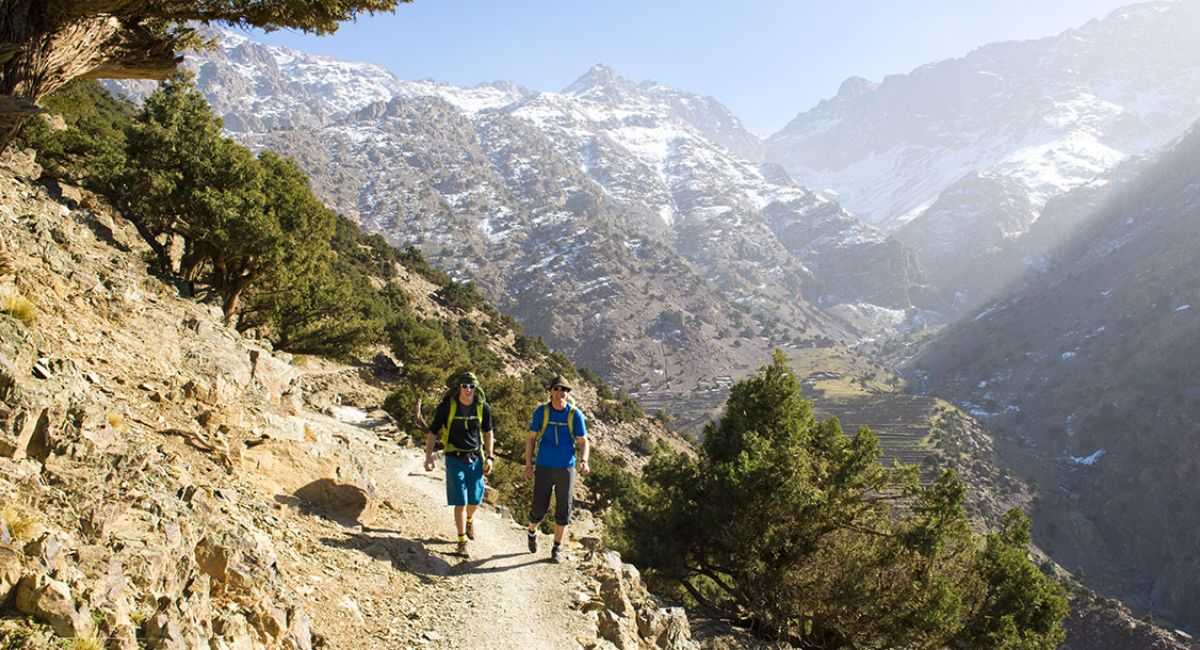
| Why Solo Works Well Here
→ Complete freedom over your pace and route → Local guesthouses genuinely welcoming to solo travellers → Guides available on arrival — no pre-booking needed → Easy to join small group tours if you want company → Mountain hospitality culture is exceptionally warm → Meeting other travellers at Imlil guesthouses is natural |
What to Think About First
! A guide is required for Toubkal and the national park routes ! Solo hiking on unmarked trails carries real navigation risk ! Weather can change fast — harder to manage alone ! Mobile signal is limited in the High Atlas ! Emergency contact protocol matters more when solo ! Let your guesthouse know your planned route each day |
Getting to Imlil as a Solo Traveller
Imlil is the natural base for any solo travel Atlas Mountains experience. The village sits about 60 km south of Marrakech and around 90 minutes by road. Getting there independently is straightforward: shared taxis (grands taxis) run between Marrakech’s Bab er-Rob taxi stand and Asni, and from Asni another shared taxi covers the remaining stretch to Imlil. The journey is inexpensive and gives an immediate sense of the mountain landscape.
Alternatively, private taxis from Marrakech can be negotiated directly and are more comfortable for luggage-heavy arrivals. Several Marrakech-based operators, including MT Toubkal Trek, also offer transfers to Imlil as part of guided options, which takes the navigation out of the first day. For a broader look at how Imlil fits into Marrakech day-trip options, see our day trips from Marrakech guide.
Accommodation for Solo Travellers in Imlil
Imlil has a well-established guesthouse scene that genuinely caters to solo visitors — partly because the village sits on the main Toubkal trekking route and has been receiving independent travellers for decades. Most guesthouses offer single room options or will happily rent a double room to a solo traveller at a reasonable rate. Breakfast is almost always included.
The guesthouse experience itself is part of what makes solo travel in the Atlas Mountains so rewarding. Evenings tend to involve communal dinners where you naturally end up sharing a table with other travellers — fellow solo visitors, small groups on their way to Toubkal, hikers returning from the valleys. The social side takes care of itself without anyone needing to engineer it.
| Solo accommodation tip: Book at least your first night in Imlil before arriving. It’s not strictly necessary during quiet periods, but arriving in a mountain village at dusk without a bed confirmed is an avoidable stress. WhatsApp contact numbers for most Imlil guesthouses are easily findable online. |
Routes Suitable for Solo Atlas Mountains Travel
Not all routes around Imlil carry the same solo-travel considerations. Here’s a clear-eyed breakdown:
| Route | Difficulty | Duration | Solo-Friendly? |
| Imlil to Aroumd | Easy | 2-3 hrs | ✓ Yes — well marked |
| Valley Loop (Berber villages) | Easy | 2-3 hrs | ✓ Yes, with basic map |
| Tamatert Pass | Moderate | 4-5 hrs | ✓ Guide recommended |
| Tachdirt Village Walk | Moderate | 6-7 hrs | ⚠ Guide strongly advised |
| Toubkal Summit Trek | Challenging | 2-3 days | ✗ Guide legally required |
The Imlil hiking trails guide covers each of these routes in more detail, including timings and what to expect underfoot. For solo travellers, the general principle is: the easier and more-used the trail, the more independently walkable it is. The more technical or remote the route, the more a local guide adds genuine safety value.
Do You Need a Guide for Solo Atlas Mountains Travel?
This is probably the most common question in any solo travel Atlas Mountains guide, and the answer has two parts. For most of the short day-hike routes around Imlil — the walks to Aroumd, the valley loops, the Tamatert viewpoint — a guide is not legally required, and many solo travellers complete these independently with a good map and basic trail awareness.
For the Toubkal summit and routes within the national park, a licensed local guide is a legal requirement, full stop. This applies to all visitors regardless of experience level. It’s not bureaucracy for its own sake — the navigation challenges, altitude, and weather exposure on the upper mountain are genuine, and local guides who’ve summited Toubkal hundreds of times carry knowledge that’s not replicated by GPS apps or trail descriptions.
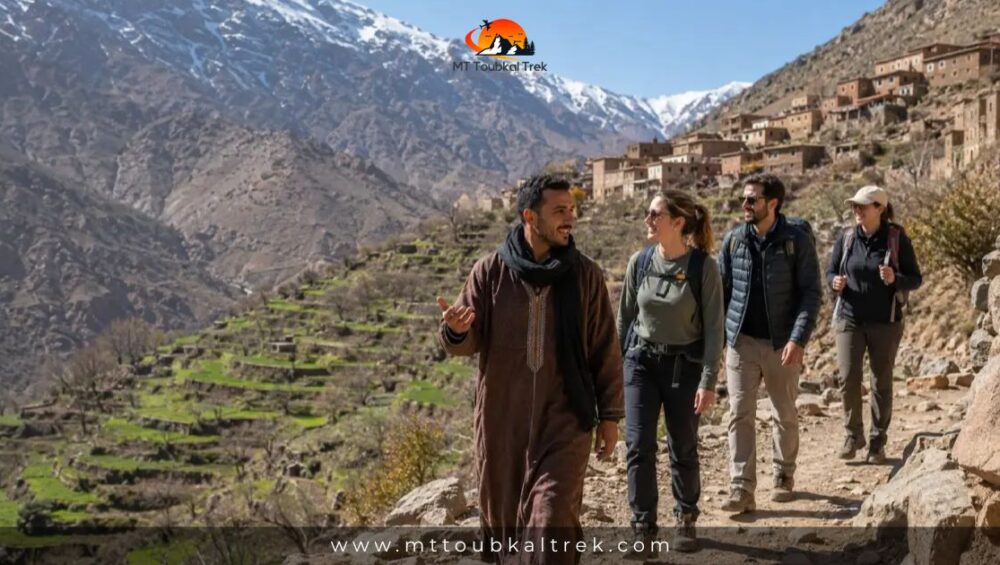
For those who’d rather trek with a guide even on the shorter routes, the guide association in Imlil operates out of the village, and guides can be hired on arrival without advance booking — a significant practical advantage for solo travellers who arrive without fixed plans. MT Toubkal Trek can also arrange licensed guides for any route through the complete Atlas Mountains hiking guide.
Safety for Solo Travellers in the Atlas Mountains
| Safety Overview |
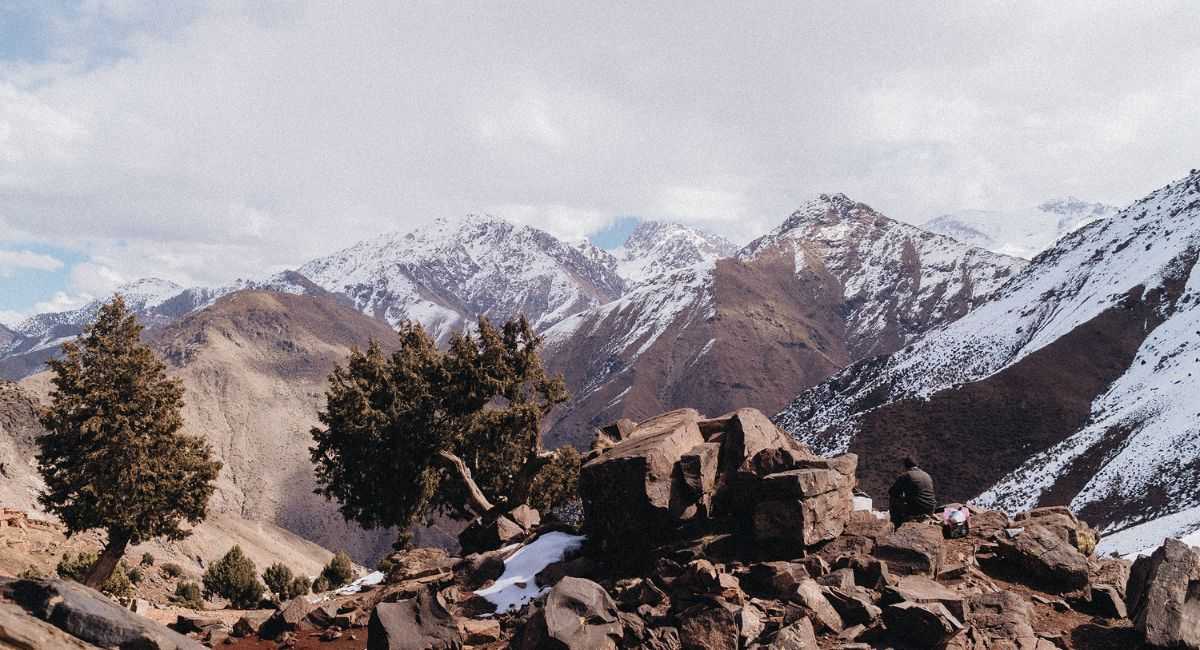
| The Atlas Mountains around Imlil are genuinely safe for solo travel by the standards of mountain destinations globally. The region is well-established as a trekking destination; the local community around Imlil is used to international visitors, and petty crime is rare. The safety considerations that matter here are environmental rather than security-related. |
Weather Awareness
Mountain weather in the High Atlas can shift quickly, particularly in spring and autumn — the two best seasons for solo travel in the Atlas Mountains. Clear mornings can turn overcast by mid-afternoon and bring rain or hail at higher elevations. Check conditions before heading out on longer routes, carry a waterproof layer regardless of the forecast, and have a turn-back plan for any route above 2,500 metres.
Navigation
Main routes to and from Imlil are reasonably well-trodden and marked, but the High Atlas is not a fully signposted national park network. Solo travellers who leave the main trails without a guide or offline navigation tools (Maps.me and OsmAnd both cover the area well) run a real risk of getting genuinely lost. Download your offline maps before leaving Marrakech — mobile signal in the upper valleys is unreliable.
Altitude
If you’re planning any route above 3,000 metres, including the approach to Toubkal, understand the signs of altitude sickness: persistent headache, nausea, dizziness, breathlessness at rest. Descend immediately if symptoms become severe. More details in our Atlas Mountains trekking tips guide.
Communication
Tell your guesthouse your planned route and expected return time every day you head out. This is the single most important solo safety habit. It costs nothing and means that if you don’t return when expected, someone who knows the terrain and the local emergency contacts is aware.
Solo Women Travellers in the Atlas Mountains
Women travelling alone in the Atlas Mountains report a generally positive experience, particularly around Imlil, where the local community has decades of experience with international visitors of all backgrounds. The Berber villages along the main routes tend to be respectful of solo women travellers in a way that isn’t universally true of urban Morocco.
Practical recommendations that specifically apply: modest clothing (covered shoulders and knees) is appropriate in village settings and is also the most practical option for sun and wind protection. Hiring a guide — even for routes that are technically walkable solo — adds a layer of cultural navigation that many solo women travellers find genuinely valuable beyond just trail-finding. Staying at a well-reviewed guesthouse where staff are accustomed to solo female guests makes the arrival experience considerably more comfortable.
Best Time of Year for Solo Atlas Mountains Travel
April to May and September to November are the best seasons for solo travel in the Atlas Mountains. Spring brings wildflowers, manageable snow at altitude, and mild temperatures. Autumn offers clear skies, cooling air, and noticeably fewer people on the trails — a particular benefit for solo travellers who want the mountains without the peak-season crowds.
Summer (June to August) is hot in the valleys but cooler at altitude and still viable for most routes. Winter (December to March) brings snow and ice above 2,500 metres, adding technical difficulty that changes the solo travel Atlas Mountains calculus significantly — a guide becomes even more valuable in these conditions. Our guide on the best time to travel in Morocco covers the broader seasonal context.
What to Pack for a Solo Atlas Mountains Trip
Packing for solo travel in the Atlas Mountains follows the same core principles as any mountain travel, with one important solo-specific note: you’re carrying everything yourself with no one to share the load. This makes the case for packing light more compelling than usual.
Non-negotiable items
Layered clothing system (moisture-wicking base, fleece mid-layer, waterproof outer), broken-in hiking boots with ankle support, offline maps downloaded before you leave Marrakech, a headtorch, a basic first aid kit, sun protection (hat, high-factor suncream, sunglasses), and more water than you think you’ll need for any day above 2,000 metres.
Solo-specific additions
A personal locator beacon or satellite communicator is worth considering for anyone planning to spend extended time above 3,000 metres without a guide. A whistle. A fully charged external battery pack, since charging options are limited in mountain guesthouses and nonexistent on the trail.
| Pack tip: Leave anything you don’t need for the mountain at your Marrakech accommodation or with your Imlil guesthouse. Most guesthouses will store a bag while you’re on the trail, meaning you only carry what’s actually needed for the day or overnight. |
KEY TAKEAWAYS
| 1 | Solo travel in the Atlas Mountains is genuinely well-suited to independent travellers — Imlil has decades of experience with solo visitors and the infrastructure to support them. |
| 2 | Shorter routes around Imlil are walkable independently. The Toubkal summit and national park routes legally require a licensed local guide. |
| 3 | Tell your guesthouse your planned route and return time every morning — this single habit is the most important solo safety practice. |
| 4 | Download offline maps before leaving Marrakech. Mobile signal is unreliable in the upper valleys and nonexistent on many trails. |
| 5 | April–May and September–November are the best seasons for solo travel Atlas Mountains trips — stable weather, clear trails, fewer crowds. |
| 6 | Women travelling solo report positive experiences around Imlil, specifically hiring a guide for cultural navigation as well as trail-finding is widely recommended. |
| 7 | Pack light — you’re carrying everything yourself. Store non-essentials in your guesthouse and only take what you need for the day or overnight. |
Frequently Asked Questions
Is it safe to travel solo in the Atlas Mountains?
Yes, genuinely. The Atlas Mountains around Imlil are a well-established, safe trekking destination. The safety considerations that matter are environmental — weather, navigation, altitude — rather than security-related. Following basic mountain safety habits (telling your guesthouse your route, carrying a map, and having a turn-back plan) covers the main risks.
Can women travel solo in the Atlas Mountains?
Yes. Solo women travellers consistently report positive experiences in the Atlas Mountains region, particularly around Imlil where the community has long experience with international visitors. Modest clothing in village settings, a well-reviewed guesthouse, and optionally a local guide for cultural navigation as well as trail knowledge are the practical recommendations most solo women travellers find useful.
Do I need to book a guide in advance for solo Atlas Mountains travel?
Not necessarily. The guide association in Imlil operates from the village, and guides can be hired on arrival without pre-booking for most routes. For the Toubkal summit specifically, booking in advance is advisable during peak season (April–May and September–October) when demand is high. For shorter day routes, arriving and arranging in the morning is perfectly practical.
How do I get to Imlil from Marrakech on my own?
Shared grands taxis from Bab er-Rob taxi stand in Marrakech go to Asni, from where another shared taxi covers the final stretch to Imlil. The journey takes around 90 minutes total and is inexpensive. Alternatively, private taxis can be negotiated from Marrakech for a more direct journey. Most guesthouses in Imlil can also arrange a pickup.
Conclusion
Few destinations reward solo travel Atlas Mountains trips quite as naturally as the High Atlas does. Travelling independently, at your own pace, in genuine mountain terrain — with a culture of hospitality toward solo visitors and routes that scale from gentle to genuinely demanding — makes this a destination that works across a wide range of solo travel styles and experience levels.
The key is going in with the right information — knowing which routes are appropriate to walk independently, understanding the guide requirements, packing for both ends of the temperature range, and telling your guesthouse where you’re going each day. Get those basics right, and what awaits is one of the more memorable solo travel experiences Morocco has to offer: mountain silence, Berber hospitality, and a landscape that’s been earning its reputation for generations.
If you’d like a guided experience that still gives you the freedom and pace of solo travel — without the navigational logistics — MT Toubkal Trek runs Atlas Mountains treks for all experience levels. Solo travellers are welcome on both group and private departures. Get in touch to find the right option for your trip.
| Ready to Trek the Atlas Mountains?
MT Toubkal Trek offers guided Atlas Mountains treks for solo travellers — private and group departures, licensed guides, and routes matched to your experience level. |