Morocco is one of the very few countries where you can genuinely experience two completely different landscapes — towering mountain peaks and vast Saharan sand dunes — within a single, well-paced trip. This Morocco Atlas Sahara itinerary is built around exactly that combination, taking in the High Atlas Mountains, the dramatic kasbah country around Ouarzazate, and the Erg Chebbi dunes near Merzouga, all in seven days.
This isn’t a rushed checklist tour. It’s a route that’s been refined over years of running these exact stages with travellers, designed to give each region enough time to actually register rather than just ticking a box. What follows is a complete day-by-day breakdown, along with guidance on how to adapt it to your own timeline.
Why Combine the Atlas Mountains and the Sahara
Most first-time visitors to Morocco eventually face the same decision covered in our Atlas Mountains vs Sahara Desert comparison — which region to prioritise if time is limited. The honest answer, for anyone with a week or more, is that you don’t have to choose. The two regions sit on the same overland route south from Marrakech, and the landscapes in between — kasbahs, gorges, palm-lined valleys — are genuinely worth the journey on their own merits.
There’s also a real contrast effect at play. Descending from the cool, green valleys of the Atlas Mountains into the flat, golden expanse of the Sahara makes both halves of the trip feel more vivid by comparison. Travellers who’ve done this route consistently mention it as one of the more memorable transitions of any trip they’ve taken.
| “By the time you reach the dunes, the mountains feel like a different country. That contrast is half the reason this route works so well.” |
Route Overview
The full Morocco Atlas Sahara itinerary follows this general path:
| ●
Marrakech |
→ | ●
Imlil |
→ | ●
Ouarzazate |
→ | ●
Draa Valley |
→ | ●
Merzouga |
→ | ●
Marrakech |
This loop covers roughly 1,100 km of driving over the course of the week, broken into manageable daily stretches with stops built in along the way. It’s designed as a round trip back to Marrakech, though it can be adapted to end in Fes instead for those wanting a one-way crossing of the country.
Day 1: Arrival in Marrakech
| Day 1: Arrival in Marrakech [CITY] |
| Most international flights land in Marrakech, so day one is generally an arrival and orientation day. After settling into accommodation, exploring the medina and souks is the natural first activity — Jemaa el-Fnaa square, the narrow alleyways of the souks, and a first taste of Moroccan food set the tone for the trip ahead.
This is also a sensible day to confirm logistics for the days ahead, particularly transport to Imlil the following morning, and to adjust to the time zone and pace of the city before heading into the mountains. Location: Marrakech Pace: Light, orientation Highlight: Medina & souks |
Day 2: Marrakech to Imlil, Atlas Mountains
| Day 2: Marrakech to Imlil [ATLAS MOUNTAINS] |
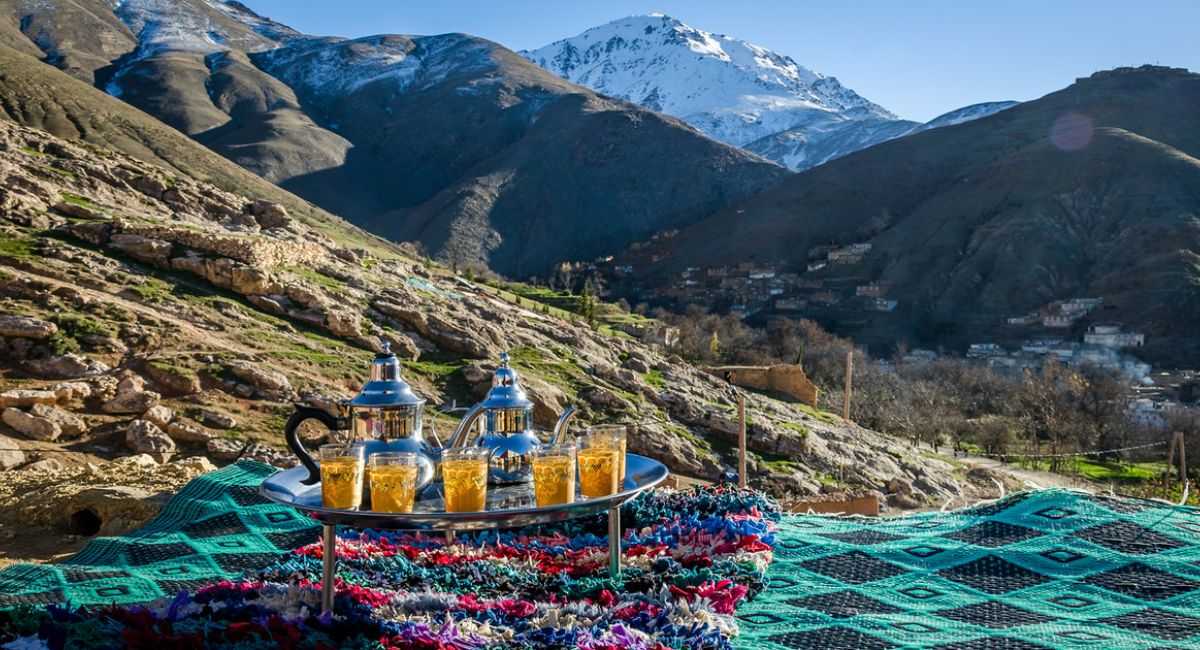
| The drive to Imlil takes around 90 minutes from Marrakech, and the change in scenery is immediate — from the flat plains around the city to winding mountain roads lined with walnut and almond trees. Imlil sits at the foot of the High Atlas and serves as the gateway to Jebel Toubkal, North Africa’s highest peak.
The afternoon is well spent on a gentle orientation walk, such as the route to nearby Aroumd village, getting a feel for the valley and the rhythm of Berber mountain life before the more active hiking day ahead. → Scenic drive through the High Atlas foothills → Arrival in Imlil, gateway to Toubkal → Gentle afternoon walk to acclimatise Drive time: ~90 minutes Pace: Easy, settling in Overnight: Imlil |
Day 3: Imlil Trekking Day
| Day 3: Imlil Trekking Day [ATLAS MOUNTAINS] |
| This is the dedicated mountain day, and there’s genuine flexibility in how it’s used. For those wanting an active full day, a longer hike toward higher terrain or one of the more demanding Imlil hiking trails delivers a proper sense of the High Atlas without committing to the full multi-day Toubkal summit trek.
For those who’d prefer a gentler pace, a half-day walk through Berber villages combined with an afternoon rest before the long drive ahead works just as well. Either way, this is the day that gives the Atlas Mountains portion of the trip its proper due before moving toward the desert. → Full or half-day hiking, scaled to fitness → Views across the Mizane Valley → Time in Berber villages along the route Activity: Day hike (flexible) Pace: Active Overnight: Imlil |
Day 4: Imlil to Ouarzazate via Tizi n’Tichka
| Day 4: Imlil to Ouarzazate [TRANSITION] |
| This is the first major transition day, crossing the High Atlas via the Tizi n’Tichka pass, one of the most dramatic mountain roads in Morocco. The drive itself, at around 4-5 hours including stops, is genuinely scenic, with switchback roads, roadside viewpoints, and a gradual shift in landscape and architecture as you descend toward Ouarzazate.
Ouarzazate is often called the gateway to the south, and a stop at the nearby Ksar Ait Ben Haddou — a UNESCO World Heritage fortified village — is essentially mandatory on this route. It’s one of the most photographed sites in Morocco, and walking through its narrow passages gives a tangible sense of pre-Saharan architecture. → Crossing the Tizi n’Tichka pass (2,260m) → Visit to Ksar Ait Ben Haddou, UNESCO World Heritage site → Arrival in Ouarzazate by evening Drive time: ~4-5 hours Pace: Moderate, scenic Overnight: Ouarzazate |
Day 5: Ouarzazate to Merzouga via the Draa Valley
| Day 5: Ouarzazate to Merzouga [TRANSITION] |
| The longest driving day of the trip, typically 7-8 hours including stops, but one that’s broken up well by the scenery along the way. The route follows the Draa Valley, Morocco’s longest river valley, lined with palm groves and traditional kasbahs that stand in striking contrast to the increasingly arid landscape surrounding them.
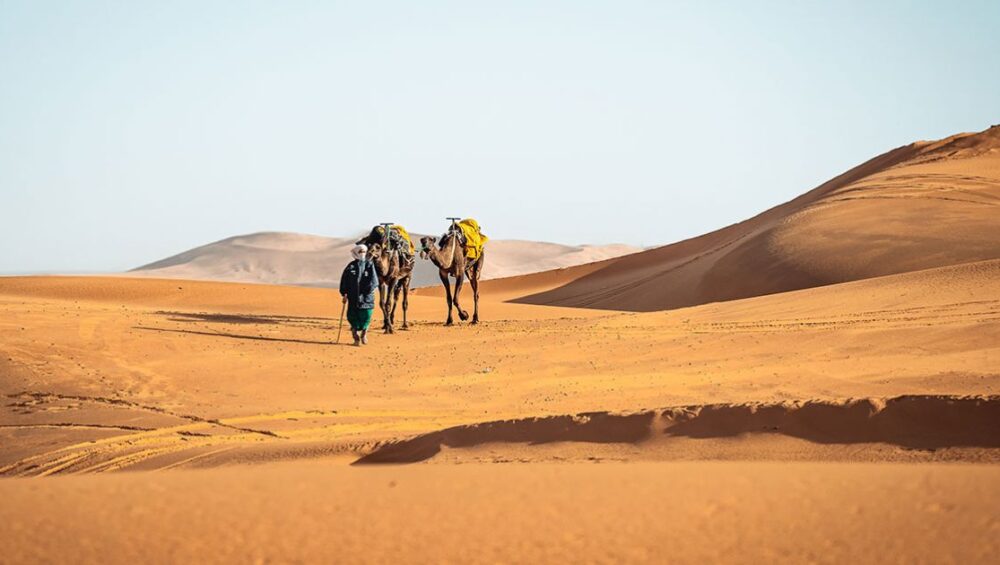
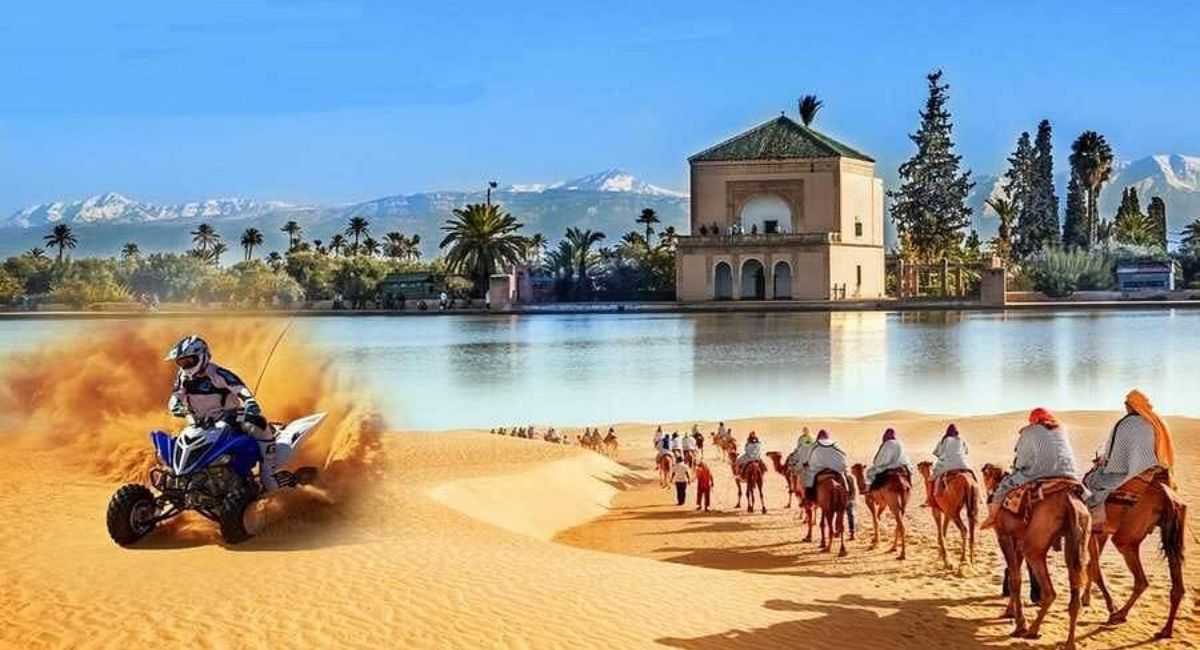
By late afternoon, the road approaches Merzouga, and the first views of the Erg Chebbi dunes appear on the horizon — a moment that consistently gets mentioned as one of the trip’s highlights. Camels meet the group at the edge of the dunes for the trek into camp as the light turns golden. → Drive through the Draa Valley palm groves → First sight of the Erg Chebbi dunes → Sunset camel trek into the desert camp Drive time: ~7-8 hours Pace: Long but scenic Overnight: Desert camp |
Day 6: Merzouga, Sahara Desert
| Day 6: Merzouga, Sahara Desert [SAHARA] |
| A sunrise dune climb is the natural way to start the day, with the early light turning the sand from pale gold to deep amber, often with the camp still quiet below. The rest of the day in Merzouga offers a genuine range of optional activities — sandboarding on the dunes, a 4×4 excursion to the Khamlia village known for its Gnawa music, or simply resting at camp and absorbing the silence of the desert in daylight.
A second night in the dunes, if the itinerary allows, deepens the experience considerably — the stargazing on a clear desert night is genuinely one of the best in North Africa, with the Milky Way visible to the naked eye away from any light pollution. → Sunrise dune climb → Optional sandboarding or 4×4 excursion → Second night of desert stargazing Activity: Flexible, desert-based Pace: Relaxed Overnight: Desert camp |
Day 7: Return to Marrakech
| Day 7: Return to Marrakech [RETURN] |
| The return leg can be done as a long single drive back to Marrakech, or broken into a final overnight stop, depending on flight schedules and how much driving fatigue the group is carrying by this point. Many groups choose to return via the Dadès or Todra Gorges for a final scenic stop before reaching the city, adding texture to the journey rather than simply retracing the outbound route.
Arriving back in Marrakech in the evening allows time for a final dinner and a chance to reflect on a trip that’s covered an extraordinary range of Moroccan landscapes in a relatively compact week. Drive time: ~8-9 hours (or split) Pace: Long, optional stop Overnight: Marrakech |
Itinerary at a Glance
| Day | Route | Region | Overnight |
| Day 1 | Arrival | City | Marrakech |
| Day 2 | Marrakech → Imlil | Atlas Mountains | Imlil |
| Day 3 | Imlil trekking day | Atlas Mountains | Imlil |
| Day 4 | Imlil → Ouarzazate | Transition | Ouarzazate |
| Day 5 | Ouarzazate → Merzouga | Transition | Desert camp |
| Day 6 | Merzouga, Sahara | Sahara Desert | Desert camp |
| Day 7 | Return to Marrakech | Return | Marrakech |
Adapting the Route
This Morocco Atlas Sahara itinerary is a framework rather than a fixed structure, and it adapts reasonably well in either direction depending on available time.
| Shorter (5-6 Days)
Reduce the Atlas Mountains portion to a single day rather than two, or shorten the desert stay to one night instead of two. The core route stays intact, just compressed. |
Longer (9-10 Days)
Add a day or two in the Atlas for a proper Toubkal summit attempt, or extend the desert stay, and consider finishing via Fes and the Imperial Cities instead of returning to Marrakech. |
| Worth knowing: The two long driving days — Day 4 and Day 5 — are the parts of this itinerary most worth protecting if you’re tempted to compress the schedule. Rushing them means missing the kasbahs and valley scenery that make the journey between regions worthwhile in its own right. |
KEY TAKEAWAYS
| 1 | This Morocco Atlas Sahara itinerary runs 7 days, starting and ending in Marrakech, covering the High Atlas Mountains, kasbah country, and the Sahara Desert. |
| 2 | Two nights are spent in Imlil in the Atlas Mountains, allowing a full trekking day without rushing. |
| 3 | Ksar Ait Ben Haddou and the Draa Valley are essential stops on the transition days between regions, not just driving days. |
| 4 | Two nights in the Merzouga desert allow time for sunrise dune climbing, optional activities, and proper stargazing. |
| 5 | The route covers roughly 1,100 km, with the longest single driving day running 7-8 hours between Ouarzazate and Merzouga. |
| 6 | October-November and March-April are the best windows, when both the Atlas Mountains and the Sahara are near their seasonal best simultaneously. |
| 7 | The itinerary scales easily shorter or longer, depending on available time, without losing the core mountains-to-desert structure. |
Frequently Asked Questions
Is 7 days enough for an Atlas Mountains and Sahara Desert itinerary?
Yes, 7 days is a well-balanced minimum for covering both regions without feeling rushed. It allows roughly 2 days in the Atlas Mountains, 2-3 days travelling to and experiencing the Sahara, and the remaining time for key stops along the route like Ksar Ait Ben Haddou and the Draa Valley.
Should this itinerary start and end in Marrakech?
Most versions of this route start and end in Marrakech, since it’s the most accessible international gateway and sits closest to both the Atlas Mountains and the start of the desert route. Some travellers choose to end in Fes instead, turning it into a one-way crossing of the country via the Imperial Cities.
How much driving is involved in this itinerary?
A reasonable amount, particularly on the days transitioning between regions. The longest single driving day typically runs 7-8 hours between Ouarzazate and Merzouga, though this is usually broken up with stops at kasbahs and viewpoints along the way rather than driven straight through.
Can this itinerary be shortened or extended?
Yes, it’s a flexible framework rather than a fixed structure. Cutting a day from the Atlas Mountains portion or from the desert stay are the easiest adjustments for a shorter trip, while extending by a day or two allows more time at any single stop, particularly Merzouga, or room for a proper Toubkal summit attempt.
Conclusion
This Morocco Atlas Sahara itinerary is built around a simple idea: that the country’s two most iconic landscapes are close enough together, and different enough from each other, that seeing both properly in one trip is genuinely achievable without compromising the depth of either experience. Seven days is enough time to trek in the High Atlas, stand inside a UNESCO World Heritage kasbah, and sleep under one of the clearest night skies in North Africa, all without feeling like the trip was rushed.
The framework above works as written, but it’s also flexible enough to bend around your own timeline, fitness level, and interests. Whether that means adding a day for a full Toubkal summit attempt or trimming the desert stay to fit a tighter schedule, the core structure — mountains, kasbah country, desert, return — holds up well either way.
If you’d like this route built around your specific dates, or want a guide who knows every stage of it personally, MT Toubkal Trek runs this exact Morocco itinerary regularly and can tailor it to your group. Get in touch to start planning.